
Restorative Care
Crowns
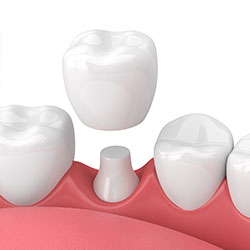
Crowns are a cosmetic restoration used to strengthen a tooth or improve its shape. Crowns are most often used for teeth that are broken, worn, or partially destroyed by tooth decay.
Crowns are "cemented" onto an existing tooth and fully cover the portion of your tooth above the gum line. In effect, the crown becomes your tooth's new outer surface. Crowns can be made of porcelain, metal, or both. Porcelain crowns are most often preferred because they mimic the translucency of natural teeth and are very strong.
Crowns or onlays (partial crowns) are needed when there is insufficient tooth strength remaining to hold a filling. Unlike fillings which apply the restorative material directly into your mouth, a crown is fabricated away from your mouth. Your crown is created in a lab from your unique tooth impression which allows a dental laboratory technician to examine all aspects of your bite and jaw movements. Your crown is then sculpted just for you so that your bite and jaw movements function normally once the crown is placed.
Bridges
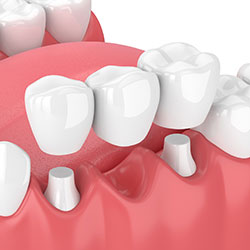
A bridge may be used to replace missing teeth, help maintain the shape of your face, and alleviate stress on your bite.
A bridge replaces missing teeth with artificial teeth, looks great, and literally bridges the gap where one or more teeth may have been. Your bridge can be made from gold, alloys, porcelain, or a combination of these materials, and is bonded onto surrounding teeth for support.
The success of any bridge depends on its foundation — the other teeth, gums, or bone to which it is attached. Therefore, it's very important to keep your existing teeth, gums, and jaw healthy and strong.
Extractions
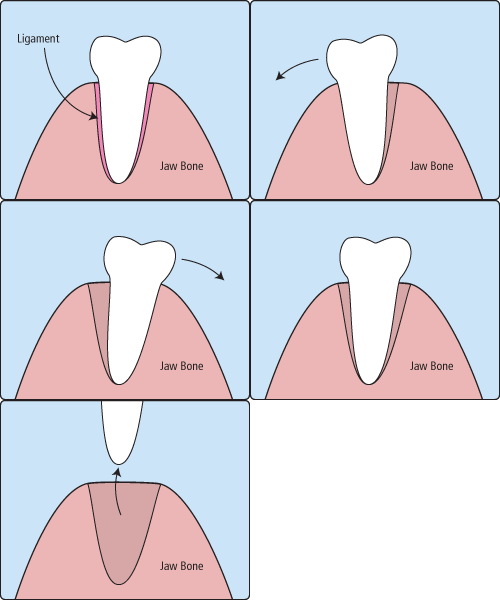
There are times when it is necessary to remove a tooth. Sometimes a baby tooth has misshapen or long roots that prevent it from falling out as it should, and the tooth must be removed to make way for the permanent tooth to erupt. At other times, a tooth may have so much decay that it puts the surrounding teeth and jaw at risk of decay, so your doctor may recommend removal and replacement with a bridge or implant. Infection, orthodontic correction, or problems with a wisdom tooth can also require removal of a tooth.
When it is determined that a tooth needs to be removed, your dentist may extract the tooth during a regular checkup or may schedule another visit for this procedure. The root of each tooth is encased within your jawbone in a "tooth socket," and your tooth is held in that socket by a ligament. In order to extract a tooth, your dentist must expand the socket and separate the tooth from the ligament holding it in place. While this procedure is typically very quick, it is important to share with your doctor any concerns or preferences for sedation.
Once a tooth has been removed, neighboring teeth may shift, causing problems with chewing or with your jaw joint function. To avoid these complications, your dentist may recommend that you replace the extracted tooth.
Dentures
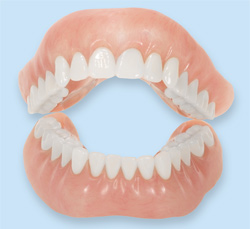
Dentistry is all about smiles, and having a confident, healthy, beautiful smile is important even for patients wearing dentures. Our practice provides personalized denture services that meet the needs and comfort levels of our patients. All of our patients are unique and we create one-of-a-kind dentures that feel good and look natural.
What are dentures?
Dentures are natural-looking replacement teeth that are removable. There are two types of dentures: full and partial.
- Full dentures are given to patients when all of the natural teeth have been removed. Conventional full dentures are placed after the gum tissue has healed, which can take several months. Immediate full dentures are placed immediately after the teeth have been removed and may require frequent adjustments during the first couple of months of use.
- Partial dentures are attached to a metal frame that is connected to your natural teeth and are used to fill in where permanent teeth have been removed. Partial dentures are considered a removable alternative to bridges.
How do I know if dentures are the right choice for me?
Dentures are not for everyone. If you're interested in learning more about dentures and want to know if they are the right choice for you, please schedule an appointment. Our team will be happy to answer any questions you might have, and can determine the best course of treatment for your ongoing dental health.
Caring for your dentures
Dentures, just like natural teeth, require daily maintenance to stay clean and keep bacteria from growing inside of your mouth. Keep your dentures clean and your smile healthy:
- When handling your dentures, stand over a clean, folded towel or a sink full of water. This way, if you accidentally drop your dentures, they are less likely to break.
- Your dentures are not immune from plaque and tartar build-up, so it's important that you brush your dentures every day. To brush your dentures, use a soft-bristled brush and gently brush the surfaces of the dentures, being careful not to break or bend the plastic. Between brushings, it's important to rinse your dentures after each meal.
- Use a gentle cleanser to clean your dentures. Many toothpastes, household cleaners, and mouthwashes can be too hard on your dentures, so it is recommended that you use a mild hand or dish soap to get your dentures clean. Be sure to check for the American Dental Association (ADA) seal of approval to choose products that are safe for your dentures, or ask your dentist about which products may be best for you.
- When you are not wearing your dentures, they need to be kept moist. Dentures that are not kept in a denture cleaning solution or in water can dry out, lose their shape, or even crack and break. Certain styles of dentures require certain soaking solutions, so be sure to ask your dentist which solution is best for you.
- Even if you have a full set of dentures, it's important to keep your gums and tongue clean. Be sure to use a soft-bristled brush to gently clean your gums and tongue every day.
If by chance your dentures do break, please contact our practice and schedule an appointment as soon as possible. Broken dentures that don't fit properly can cause irritation to your gums and mouth. Also, remember to continue scheduling regular dental checkups every six months to make sure that your smile stays healthy for many years to come.
Inlays & Onlays
Inlays and onlays are a type of indirect restoration, where your dentist fabricates the restoration outside of your mouth and cements it into place. A direct restoration, most commonly fillings, are placed immediately into a prepared cavity in a single visit.
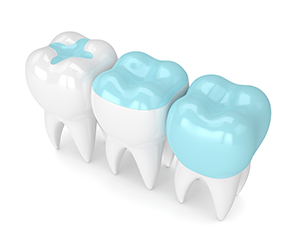
Inlays and onlays are used in molars or premolars, when the tooth has experienced too much damage to support a basic filling, but not so much damage that a crown is necessary. They can be made of gold, metal alloys, ceramics, or composites. An inlay is used when the cavity rests between the cusps, whereas an onlay covers one or more cusps, as well as the area in between. A crown replaces the entire outside area of the tooth above the gum line.
Indirect fillings generally require two or more visits. During the first visit, your dentist prepares the tooth and makes an impression of the area to be restored. Your dentist then places a temporary covering over the prepared tooth. The impression is sent to a dental laboratory, which creates the dental restoration. At the next appointment, we cement the restoration into the prepared cavity and adjust it as needed.